Let’s be real, nothing kills office productivity faster than the blinding afternoon sun bouncing off a computer screen or the thermostat fighting a losing battle against heat gain. If you’re running a business in Salt Lake City, you know exactly the kind of high-altitude glare I’m talking about—it’s intense, and it changes by the minute. It is time to talk about a solution that actually works for modern workspaces: commercial Motorized Shades.
Why Manual Blinds are Probably Costing You Money
You might look at the window coverings you have right now—those standard manual roller shades or, heaven forbid, horizontal aluminum blinds—and think they are doing “just fine.” But are they?
Here is the thing about manual shades in a commercial setting: human nature works against them. If the sun is glaring into Bob’s cubicle at 9:00 AM, he pulls the shade down. That’s reasonable. But when the sun moves at 11:00 AM and the office starts looking like a cave, does Bob get up to raise the shade? Probably not. He’s busy.
So, you end up with a building where the shades are permanently down. This means you are paying for artificial lighting when you could be using free natural light (daylight harvesting, as the pros call it), and your office feels smaller and gloomier than it needs to be.
On the flip side, if nobody lowers the shades, your HVAC system is working overtime to cool down a room that acts like a greenhouse. In Utah, where our summers are scorching and the sun is surprisingly strong even in winter, that thermal transfer is a silent budget killer. Motorized Shades aren’t just a luxury item; they are an infrastructure upgrade that manages light and heat so your employees don’t have to.
Understanding the Tech: What Makes a Shade “Commercial Grade”?
When we talk about best commercial motorized shades, we aren’t talking about the stuff you buy off the shelf at a big-box store. Commercial-grade implies durability, specific fire ratings, and heavier duty motors.
In an office, shades go through a lot of wear and tear. A motor in a commercial setting needs to handle being raised and lowered potentially multiple times a day, every day, for years. We look for high-torque motors that operate quietly. You don’t want a sound like a jet engine taking off every time the sun moves behind a cloud during a client meeting.
The Components that Matter
- The Tube: It sounds boring, but the aluminum tube the fabric rolls onto needs to be sturdy to prevent “deflection” (sagging in the middle), especially on wide windows common in SLC office parks.
- The Hembar: This is the weight at the bottom. In commercial setups, this is often wrapped in fabric or sealed to keep the look clean and prevent clanking against the glass.
- The Fascia: This is the metal box or cover at the top that hides the roller. In offices, we usually use a square Aluminum Fascia that looks sharp and modern.
The Fabric Debate: Openness Factors Explained
This is where people usually get confused, but stick with me because it’s actually pretty straightforward. When you pick a fabric for an office, you aren’t just picking a color (though we all love a nice charcoal or grey). You are picking an Openness Factor.
The openness factor refers to how tight the weave of the fabric is. It dictates how much light gets through and how much of a view you keep.
- 1% Openness: This is a tight weave. It blocks 99% of UV rays. You can barely see through it to the outside, but it offers maximum glare control and privacy. Great for conference rooms or west-facing windows that get hammered by the afternoon sun.
- 3% Openness: The industry standard for commercial offices. It hits the sweet spot. You get decent Glare Reduction, decent heat rejection, but you can still clearly see the mountains or the city skyline. It doesn’t feel like you’re trapped in a box.
- 5% to 10% Openness: These let in a lot of light and keep a great view, but they don’t do as much for glare. We often use these on North-facing windows where direct sunlight isn’t a major issue.
Solar Shades vs. Blackout: Which One Do You Need?
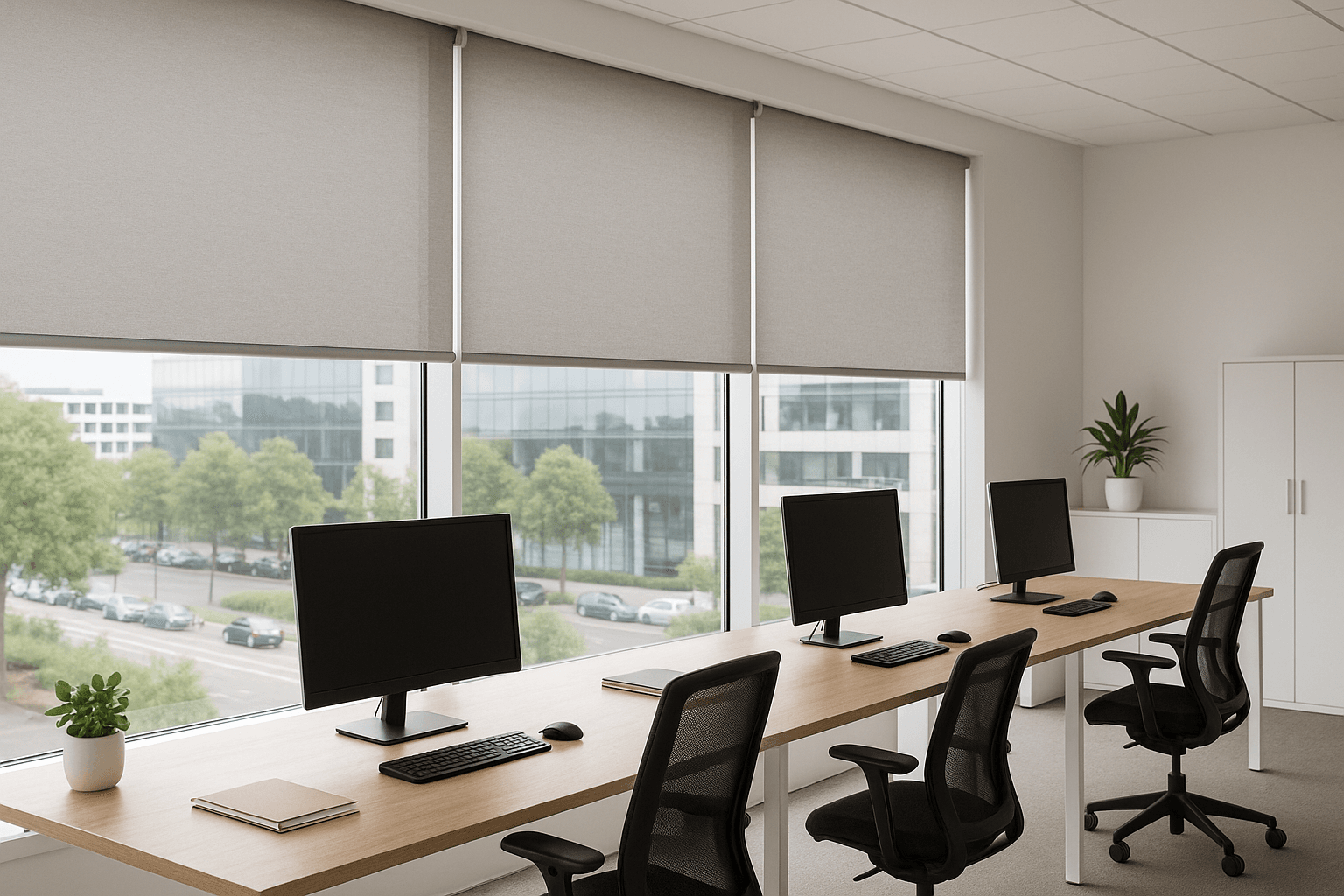
For most general office areas, open workspaces, and lobbies, Solar Shades are the winner. They cut the glare but keep the connection to the outside world. Humans generally like seeing the outdoors; it helps with circadian rhythms and keeps morale up.
However, you can’t ignore Blackout Shades.
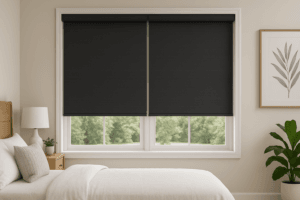
Think about your boardroom or huddle rooms. If you have a projector or a high-end display screen, even a little bit of light bleed can wash out a presentation. For these rooms, we often recommend a Blackout fabric with side channels (tracks on the side of the window) to trap all the light.
The Dual Shade Solution
Can’t decide? You don’t have to. A popular trend in executive offices and high-end boardrooms is the Dual Shade system. This setup puts two rollers on one window: one solar shade for daytime Light Filtering, and one blackout shade for when it’s time to dim the lights and focus on a video call. It’s the ultimate flexibility, though it does require a bit more mounting depth in your window frame.
Powering Up: Batteries, Hardwire, or PoE?
This is the nuts and bolts of the operation. How do we get these things moving? In the commercial world, we have three main contenders, and the winner depends heavily on whether you are building new or retrofitting an existing space.
1. Battery Powered
If you are in an older building in downtown Salt Lake or Sugar House and you can’t tear open the walls, battery motors are a lifesaver. Modern lithium-ion battery motors are powerful and hold a charge for months (sometimes up to a year depending on usage).
- Pros: Easy install, no electrician needed.
- Cons: Eventually, someone has to charge them. In an office with 50 windows, that’s a maintenance task you might want to avoid.
2. Hardwired (High Voltage)
This is the old-school standard. You run standard electrical wire to every window head. It’s reliable, powerful, and never needs a battery change.
- Pros: Infinite power, can handle huge heavy shades.
- Cons: Expensive. You need a licensed electrician to run lines to every single window.
3. Power over Ethernet (PoE)
Honestly, this is the future, and it’s what we get most excited about at PowerShades. PoE uses a standard CAT5 or CAT6 ethernet cable to send both power and data to the shade motor.
- Pros: It’s low voltage, so you often don’t need a high-voltage electrician (check local codes, of course). It creates a direct data connection to your network, meaning the shades react instantly to commands. It is incredibly stable.
- Cons: You need a PoE switch, but most modern offices have these anyway for their phones and Wi-Fi access points.
The “Utah Factor”: Why SLC Buildings Have Special Needs
I touched on this earlier, but it’s worth a deeper look. Utah is unique. We are at roughly 4,200+ feet of elevation. The atmosphere is thinner here than at sea level, meaning UV radiation is significantly higher.
That UV doesn’t just heat up your room; it destroys interiors. Carpet, expensive office furniture, artwork on the walls—it all fades faster here. Commercial motorized shades are basically sunscreen for your assets.
Furthermore, we have the “albedo effect” in the winter. When the valley is covered in snow, sunlight reflects off the ground and comes up into the windows. Standard manual blinds are usually angled to block light from above, not below. Motorized roller shades provide a flat barrier that manages that reflected light much more effectively.
Automation: It’s Not Just a Gimmick
When we talk about the best commercial motorized shades, the “motor” is only half the story. The “brains” are the other half.
You don’t want your office manager running around with a remote control pointing it at windows. That’s barely better than manual chains. You want automation.
Scenario: It’s July. The sun rises early. Your automation system knows exactly when sunrise is. The shades on the East side of the building lower automatically before the first employee even badges in, keeping the office cool. As the sun moves overhead, those shades rise to let in light, and the West-facing shades lower to block the afternoon heat.
We can integrate these shades with:
- Building Management Systems (BMS): Tie shades into HVAC and lighting.
- Voice Control: “Alexa, turn on Presentation Mode.”
- Sun Sensors: A small sensor on the window measures actual brightness and adjusts the shade in real-time.
Aesthetics and Company Culture
It might sound like a stretch, but hear me out—your office environment dictates your company culture.
If your office has mismatched, bent aluminum blinds that are gathering dust, it sends a subconscious message of “good enough.” It feels dated.
Sleek, automated roller shades that move in unison (we call it hembar alignment, and it is weirdly satisfying to watch) send a message of precision and modernity. It cleans up the lines of the room. It makes the space feel organized.
Plus, getting rid of those dangling chains isn’t just an aesthetic choice; it’s a safety and liability improvement. No loops for things to get caught in, just clean lines.
| Feature | Manual Shades | Motorized Shades |
|---|---|---|
| Energy Efficiency | Low (relies on humans) | High (automated schedules) |
| Maintenance | High (chains break, fabric touches hands) | Low (touch-free operation) |
| Aesthetics | Cluttered (chains/cords) | Clean, modern |
| UV Protection | Inconsistent | Consistent |
| Cost | Low Initial Investment | Higher Initial / High ROI |
Common Questions We Get (FAQ)
Are motorized shades loud?
Ten years ago? Yes. Today? No. The motors we use at PowerShades are whisper-quiet. You might hear a faint hum, but it won’t disrupt a phone call.
Can I control them from my phone?
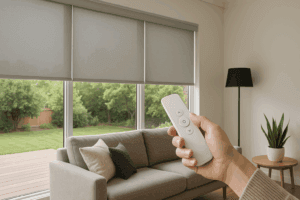
Absolutely. There’s an app for that. You can control individual shades, groups of shades, or the whole building from your smartphone, whether you are in the office or on a beach.
Do they work with Alexa or Google?
Yes. Integration is key. We can link your shades to almost any smart hub or voice assistant.
How long does installation take?
It depends on the size of the project. A single conference room can be done in a few hours. A whole floor might take a few days. The PoE Options are usually faster since we aren’t waiting on high-voltage wiring.
Making the Right Choice for Your Business
Look, upgrading to commercial motorized shades is an investment. We know that. But when you factor in the energy savings (which are significant in Utah), the protection of your interior assets, and the boost in employee comfort and productivity, the ROI becomes pretty clear.
You don’t need to be a Fortune 500 company to have a workspace that functions like one. Whether you need a single blackout shade for a media room or a full-building automation system for a new headquarters in Silicon Slopes, the Technology is accessible and scalable.
At PowerShades Utah, we don’t just sell you a product and disappear. We look at your specific exposure, your workflow, and your budget to design a system that makes sense. We know the local climate, we know the tech, and we know how to make your windows work for you, not against you.
If you are tired of the glare and ready to modernize your workspace, let’s have a chat. You can reach us directly at 801-518-5242 to discuss your project. Or, if you prefer, simply Request A Free Quote on our website and we will come out to assess your space. Let’s get that sun under control.