Summer in the Salt Lake Valley is glorious, but let’s be honest—that late afternoon sun hitting your west-facing deck feels less like a warm hug and more like an industrial heat lamp. You spend all this time and money curating the perfect outdoor living space, only to find yourself retreating indoors right when you want to be firing up the grill. If you’re looking to reclaim your backyard from the glare and the heat, you’ve probably started looking into outdoor patio shades, and that is exactly where things can get confusing.
Why Your Patio Needs More Than Just a Roof
You might think a pergola or a covered deck is enough. And sure, at noon, when the sun is directly overhead, a roof is fantastic. But here in Utah, the sun sits lower in the sky during the late afternoon—prime dinnertime—and cuts right under that roofline. We call this the “shoulder season” of the day, but it feels more like a solar assault.
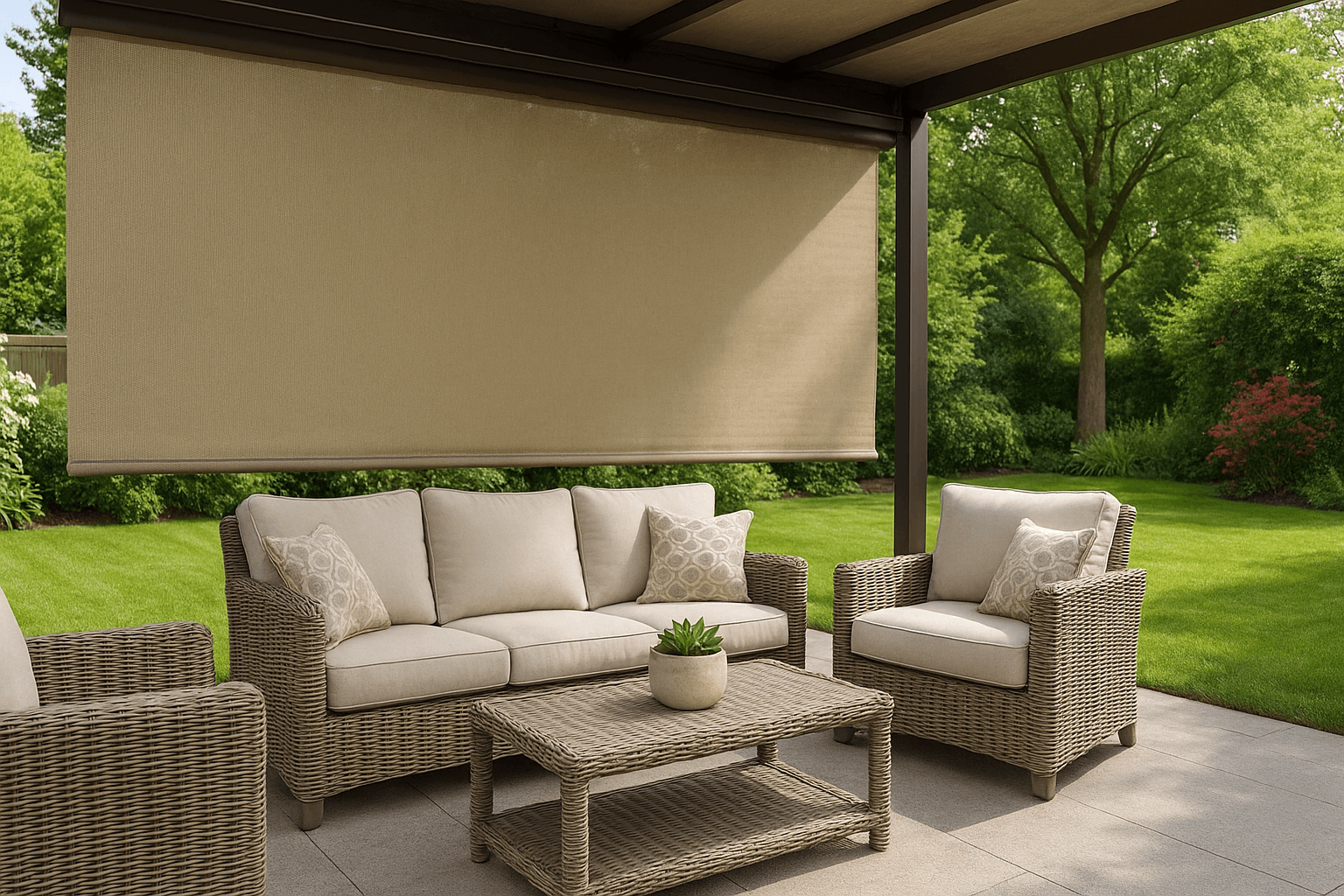
Installing exterior roller shades isn’t just about shade; it’s about temperature management. We aren’t just talking about a couple of degrees here. High-quality shades can reduce the temperature on your patio by up to 20 degrees. That is the difference between sweating through your shirt and actually enjoying your iced tea.
Plus, there’s the furniture factor. That expensive outdoor sectional you bought? The UV rays are actively bleaching the color out of it every single day. Shades act as UV protection for your investment, extending the life of your cushions and decking materials. It’s practical, sure, but it’s also about comfort.
The Heavy Hitter: Zipper Track Systems
When we talk about the “best” shades reviewed, the gold standard right now is the zipper track system.
Here’s the thing about traditional shades: they hang loose. In a place like Salt Lake City, where canyon winds can kick up out of nowhere, a loose shade is basically a sail. It flaps, it bangs against the pillars, and eventually, it tears.
A zipper track system is different. The fabric is literally zipped into side channels (tracks) that are mounted to your columns or walls. This creates a sealed edge.
Why this matters:
- Wind Resistance: Because the fabric is held taut on all sides, these shades can withstand significantly higher wind gusts than cable-guide or free-hanging shades.
- Bug Control: This is the feature people forget about until they have it. Because the track seals the edges, it keeps out wasps, flies, and those massive mosquitoes we get near the lake. It essentially turns your patio into a screened-in porch at the touch of a button.
- Privacy: No gaps on the sides means no peeking neighbors.
If you are looking for a solution that feels permanent and architectural rather than just “tacked on,” the zipper track is the way to go. It’s a retention system that handles the elements while looking incredibly sleek.
The Flexible Choice: Cable Guide Systems
Not every Home can accommodate a zipper track. Maybe you have decorative columns that aren’t perfectly square, or perhaps you’re dealing with a floating deck structure. This is where cable guide systems come into play.
Instead of a track, these shades run along stainless steel cables fixed from the mounting bracket down to the floor or railing. The bottom bar of the shade has eyelets that slide along these cables.
It’s a different vibe. It looks a bit more nautical, a bit more industrial.
While they don’t offer the total insect seal of a zipper track, they are fantastic for sun control. The cables keep the shade from swinging wildly, though you will get a little movement in heavy wind. Honestly, for many homeowners, this is the sweet spot between performance and installation flexibility. It’s robust, it works, and it doesn’t require the perfect framing that a zipper track might demand.
Let’s Talk Fabric: The “Openness Factor”
This is where most people get tripped up. You’ll see percentages like 1%, 3%, 5%, or 10% thrown around. This is the Openness Factor, and it refers to how tight the weave of the fabric is.
A lower number means a tighter weave.
- 1% Openness: Almost Blackout. It blocks 99% of UV rays. Great for privacy and intense heat, but it kills your airflow and blocks your view.
- 5% to 10% Openness: This is the sweet spot for most Utah homes. It blocks the glare and the heat, but you can still see the outline of the Wasatch Mountains through it.
You don’t want to feel like you’re sitting inside a box, right? You want to see the yard. A 5% solar screen allows you to maintain that connection to the outdoors while stopping the sun from roasting you.
| Openness Factor | Visibility | Airflow | UV Blockage | Best For |
|---|---|---|---|---|
| 1% | Low | Minimal | ~99% | Total privacy & max heat reduction |
| 3-5% | Moderate | Moderate | ~95-97% | The perfect balance for patios |
| 10% | High | Good | ~90% | Preserving views & gentle shading |
The material matters, too. You want a PVC-coated polyester or fiberglass yarn. These Fabrics are engineered to live outside. They don’t rot, they resist mold, and they are heavy enough to hang straight.
Manual vs. Motorized: The Reality Check
Look, you can save money by going with a manual crank. There is nothing wrong with that. It works. But ask yourself: are you really going to walk around to five different shades and hand-crank them up and down every time a cloud passes?
Probably not.
Motorized patio screens are where the industry has settled for a reason. With PowerShades, the motorization isn’t just a gimmick; it’s about actually using the product.
Imagine this: You’re cooking inside, and you see the sun starting to hit the patio furniture. You don’t have to stop what you’re doing. You just tap a button on your phone, or use a remote, or—even better—let the automation handle it.
We can set these systems up to lower automatically at certain times of the day. If you know the sun hits your west side at 4:30 PM, the shades can drop to 50% automatically. It keeps the patio cool before you even step outside. That is smart home integration at its finest.
And don’t worry about running wires if your house is already built. While hardwired is great for new construction, rechargeable battery motors have come a long way. They are powerful, hold a charge for months, and require zero drywall damage to install.
The Aesthetics: Will It Look Ugly?
This is the biggest fear homeowners have. You don’t want a big, bulky metal box hanging off your beautiful cedar pergola.
Modern outdoor shading systems are designed to disappear. The housing (we call it the cassette or hood) is usually compact and powder-coated to match your home’s trim. Whether you have dark bronze window frames, white stucco, or natural wood, the hardware can usually be matched to blend in.
When the shade is rolled up, you shouldn’t notice it. It should vanish. That’s the mark of a good installation. It’s there when you need it, and gone when you don’t.
Durability in the High Desert
Salt Lake City has a weird climate. We get 100-degree dry heat, followed by snow loads in winter, mixed with salt in the air during the wet season.
The hardware needs to be exterior grade. We’re talking extruded aluminum with high-quality powder coating. Plastic parts? Forget about it. They will crack in one season of Utah UV exposure.
The fabrics we use are dimensionally stable. That means they won’t stretch or sag significantly over time. Cheap big-box store shades usually warp after a season or two of heat cycles. Professional-grade solar shades are built to handle the swing from freezing winter nights to blistering summer days without losing their structural integrity.
A quick note on wind: While zipper tracks are sturdy, even the best system has limits. If we get one of those microbursts with 60mph winds, you should probably roll them up. Most smart systems can actually be paired with a wind sensor that automatically retracts the shade if things get too blustery. It’s cheap insurance for your investment.
Installation: Why DIY Usually Fails
I’m all for a good weekend project. Painting a room? Go for it. Installing a 14-foot wide motorized zipper track shade on a stucco exterior? That’s a different beast.
Installation is where the magic happens—or where the nightmare begins. The tracks need to be perfectly parallel. If they are off by even a fraction of an inch, the shade will bind, the motor will strain, and the fabric will wrinkle (we call it “smiling” or “frowning” based on the wrinkle shape).
Drilling into the exterior of your home requires knowing what is behind the siding. You don’t want to hit a header improperly or create a water leak point. Professional installers use the right anchors for brick, stucco, or wood, and they ensure the unit is leveled with laser precision.
Plus, setting the “limits” on the motor (telling it exactly where to stop at the top and bottom) can be finicky if you don’t know the programming sequence. It’s usually worth the cost to have it done right the first time, ensuring your warranty remains valid.
The Verdict: What Should You Get?
If you are in Salt Lake City and you want to actually use your patio from June through September, here is the breakdown:
If you have a covered patio with posts: Go for the Motorized Zipper Track. It offers the best wind protection, keeps the bugs out, and looks the most polished. It effectively adds square footage to your home.
If you have an open structure or irregular mounting points: Go for the Cable Guide System. It’s rugged, effective at heat control, and looks great in modern settings.
Regarding fabric: Stick to a 5% openness factor in a dark color. Surprisingly, dark colors actually offer better visibility than light colors. Light colors reflect light into your eyes (glare), while dark colors absorb the glare, allowing your eye to focus past the fabric to the view beyond.
Energy Efficiency Bonus
There is a side benefit we haven’t touched on much. If your patio shades cover windows that lead into your house (like a large sliding glass door), you are stopping the heat before it hits the glass.
Interior blinds stop the light after it has already heated up the glass and entered the room. Exterior shades block the energy outside. This can significantly lower the load on your air conditioning unit during those peak July afternoons. You’re cooling the patio, but you’re also keeping your kitchen cooler.
Ready to Reclaim Your Patio?
It’s time to stop hiding inside when the sun goes down. Your outdoor space should be comfortable, bug-free, and accessible whenever you want to use it. At PowerShades Utah, we specialize in high-end, motorized outdoor shading solutions that are built specifically for our local climate.
We can help you navigate the openness factors, choose the right mounting style, and handle the installation so it looks like it was part of the original house plan.
Give us a call today at 801-518-5242 to discuss your project. You can also visit our website to Request A Free Quote and see how we can transform your outdoor living experience.