Living right here at the base of the Wasatch Front means we get stunning mountain views, but honestly, it also means our homes get absolutely baked by high-altitude sunlight. If you have noticed your hardwood floors or that favorite living room rug looking a little washed out lately, you are probably dealing with severe UV damage. Let me walk you through the absolute best window treatments to block those harsh rays without making your Salt Lake City house feel like a gloomy, dark cave.
The Salt Lake City Sun is Gorgeous, But It’s Frying Your Stuff
Let’s be real for a second. We live at an elevation of over 4,000 feet here in the Salt Lake valley, and if you head up toward Park City or the benches, you are even higher. That thinner atmosphere is completely amazing when you are hiking up Millcreek Canyon on a Saturday morning. But for your Home? It means the sunlight hitting your south-facing and west-facing windows is practically a laser beam.
High altitude means less atmosphere to filter out ultraviolet light. Our UV index in the middle of July is no joke. You spend all this time and money curating the perfect interior—maybe you picked out a gorgeous mid-century modern leather sofa for your Sugar House bungalow, or you just installed beautiful dark walnut flooring in a new Draper build.
You know what happens next. You leave the windows totally bare because you love the view of Mount Olympus.
Then, two years later, you move an area rug and gasp. There is a glaring, sharply outlined rectangle where the sun has literally bleached the wood right out of its original color. It happens slowly, day by day, making it the silent killer of your home’s interior design. To stop this, you need UV blocking window treatments that actually do the heavy lifting while you go about your day.
The Silent Bleach: What UV Light Actually Does to Your Home
You might think the only way to stop the sun from ruining your furniture is to block out the light completely. Actually, that couldn’t be further from the truth. Let me explain how fading really works, because it is a bit of a complex recipe.
Fading is caused by three main things:
- Ultraviolet (UV) Light: This accounts for about 40% of the fading process. It breaks down the chemical bonds in dyes and wood finishes.
- Visible Light: Believe it or not, just the bright visible light contributes to about 25% of fading.
- Solar Heat: The physical heat radiating through your glass causes another 25% of the damage.
The remaining 10% comes from random things like indoor humidity and the age of the Fabrics.
So, to properly protect your stuff, you do not just need to block the invisible UV rays. You also need to manage the heat and diffuse the intense visible light. That beautiful natural light you love so much? It is a package deal with heat and radiation. Finding the right custom window shades in Salt Lake City means finding a fabric or material that tackles all three of these fading factors simultaneously.
Solar Roller Shades: The Absolute MVPs of Sun Protection
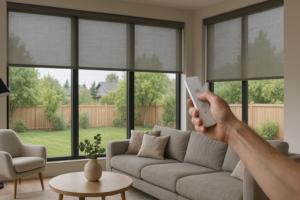
Here is the thing about solar roller shades; they are basically high-tech sunglasses for your house. If you want to keep your view of the mountains while blocking the destructive parts of the sun, this is exactly where you start.
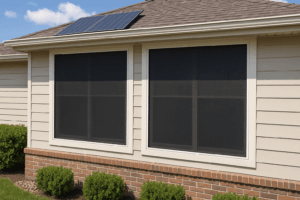
Solar shades are woven from specialized synthetic materials—often PVC-coated fiberglass or polyester—that are specifically engineered to manage solar heat gain and block UV rays.
When you start shopping for these, you are going to hear industry folks throw around a term called the “openness factor.” It sounds like technical jargon, but it is actually super simple.
The openness factor is literally just the percentage of the fabric that is open space.
- 1% Openness: Blocks 99% of UV rays. This is a tight weave. You get maximum protection, but your view outside will be pretty hazy.
- 3% to 5% Openness: The absolute sweet spot for most Utah homes. You block 95% to 97% of UV rays, but you can still clearly see the pine trees in your backyard.
- 10% Openness: Blocks 90% of UV. You get a brilliant, clear view, but you are letting in more heat and glare.
I love recommending a solid 3% openness for rooms with a lot of screens, like a home theater or a home office. It kills the glare on your computer monitor while saving your hardwood floors. Plus, they look incredibly sleek and modern.
Wait, Don’t Window Films Do the Same Thing?
You might be wondering why you shouldn’t just stick UV-blocking film directly onto your glass and call it a day.
Look, window films are fantastic. They really are. They block up to 99% of UV rays without changing the look of your window. But they have a rather annoying limitation. They are permanent.
When you apply a dark or highly reflective window film to stop the harsh summer sun, you are stuck with that exact same dark, reflective glass in the dead of January when you actually want some passive solar heat to warm up your freezing living room.
Shades give you dynamic control. You deploy them when the sun is brutal. You roll them away when you want clear, beautiful, unfiltered light on a cloudy spring morning. They adapt to your life.
Cellular Shades: The Double-Duty Heroes We Need in Utah
Let’s shift gears for a minute and talk about a completely different style: cellular honeycomb shades.
If you have lived in Utah for more than a year, you know our weather is completely bipolar. We get 100-degree scorching heat in August and sub-zero blizzard conditions in January. Your window treatments need to work hard all year round.
Cellular shades are constructed with little pockets—or honeycombs—of fabric.
These pockets trap a layer of air right next to your window glass. That trapped air acts as a massive thermal barrier. So, in the summer, they stop the baking heat from radiating into your house. In the winter, they stop your expensive furnace heat from seeping out through the cold glass.
But what about UV?
They are incredible at it. Even a light-filtering cellular shade will block nearly 95% of harmful UV rays. If you upgrade to a room-darkening or Blackout cellular shade, you are hitting 99% to 100% UV blockage. They are soft, they add beautiful texture to a room, and they practically pay for themselves by lowering your Rocky Mountain Power bill.
Comparing Your Options: A Quick Breakdown
Sometimes you just need to see the facts lined up side by side. Here is a quick look at how different styles stack up against the harsh Utah sun.
| Window Treatment Type | UV Blocking Power | Best Room to Use In |
|---|---|---|
| Solar Roller Shades | 90% – 99% (Based on openness) | Living rooms, home offices, patios |
| Cellular Honeycomb | 95% – 100% (Blocks heat too) | Bedrooms, drafty older homes |
| Plantation Shutters | Up to 100% (When fully closed) | Street-facing windows, bathrooms |
Roman Shades and Draperies: Can Fabric Really Block UV?
Okay, let’s talk aesthetics. A lot of homeowners prefer a softer, more traditional look. Maybe sleek modern roller shades just do not fit the vibe of your historic Avenues home. You want fabric. You want Roman shades or flowing drapery.
Can regular fabric protect your home?
Honestly? Unlined fabric is terrible at blocking UV. A standard cotton curtain will let UV rays slice right through, and worse, the sun will eventually rot the cotton fibers until the curtain literally shreds in your hands.
The secret weapon here is the lining.
When you purchase premium window coverings, the face fabric is just the pretty part. The heavy lifting is done by the lining sewn onto the back. A good blackout lining will completely stop UV rays dead in their tracks, protecting both the beautiful face fabric of the shade and the furniture sitting inside the room.
Even a high-quality dim-out or light-filtering lining will drastically reduce UV penetration. So yes, you can absolutely have those gorgeous, luxurious linen Roman shades. You just have to make sure they are engineered correctly on the side facing the glass.
Let’s Talk About Shutters and Blinds (Do They Work?)
I cannot write about window treatments without addressing the elephant in the room: wood blinds and plantation shutters. People love them. They are a staple in suburban Utah neighborhoods.
But here is the catch.
Real wood blinds fade. Irony, right? You buy them to block the sun, and the sun bleaches the stain right off the wood slats. If you are going to use slatted blinds in a window that gets blasted by the western evening sun, you really should consider a high-quality faux wood. Modern faux wood composites are infused with UV inhibitors, meaning they will not yellow, warp, or fade no matter how hot the glass gets.
Plantation shutters act like armor for your windows. When you shut the louvers completely, you get near 100% UV blockage. The wood is typically painted with heavily UV-resistant coatings. The downside? You have to manually tilt them closed to get the protection, and when they are closed, you lose your view entirely.
Smart Shades: Because Honestly, You’ll Forget to Lower Them
Let me explain a very human problem.
You go out and buy the absolute best automated window shades on the market. You understand the science. You know the UV index peaks at 2 PM. You have every intention of lowering your shades every single afternoon to protect your floors.
But then life happens.
You are at work. You are picking the kids up from school. You run to Harmons for groceries. The sun slowly shifts, creeps across your living room floor, and blasts your favorite artwork for three hours straight. You forgot to pull the shades down.
This is exactly why motorization is not just a fancy luxury anymore; it is functional protection.
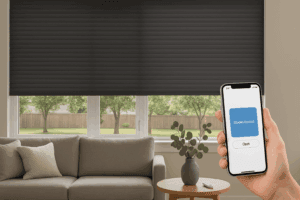
By integrating smart motors—like Somfy or specialized PowerShades Technology—you take human error completely out of the equation. You can program your shades to automatically lower to 50% exactly at 1:00 PM every day during the summer.
Better yet, you can use a smart home hub to tie the shades to a sun sensor. If the sensor detects direct, harsh sunlight hitting the glass, it triggers the shades to drop automatically. When a cloud rolls over and the light softens, the shades quietly roll back up. You literally do not have to lift a finger, and your home is constantly protected from UV damage.
Protecting Your Business: Commercial Window Treatments
We have talked a lot about homes, but what about the businesses out there?
If you run a restaurant in downtown Salt Lake or manage an office building in Silicon Slopes, UV and glare are massive liabilities. Patrons do not want to eat dinner while squinting into the blinding setting sun. Employees cannot code or write emails if the glare on their monitor is giving them a migraine.
For commercial spaces, heavy-duty commercial window shades are a necessity. You need materials like Phifer Sheerweave that are certified for commercial fire codes, easy to clean, and incredibly durable.
A restaurant with massive glass windows can lose a fortune in air conditioning costs during the summer. Dropping a 3% solar shade across the storefront lowers the ambient temperature instantly, keeps the diners comfortable, and stops the upholstery on your expensive booth seating from cracking and fading. It is a smart business investment that pays dividends in energy savings and customer comfort.
Wrapping It Up: Protecting Your Home Without Living in a Cave
You do not have to choose between enjoying the beautiful Utah scenery and protecting your interior. That is a false compromise.
The technology behind modern fabrics has advanced so much over the last decade. Whether you choose the sleek, modern efficiency of a solar roller shade, the insulating power of a honeycomb cellular shade, or the classic beauty of a lined Roman shade, you can block the destructive UV rays while still letting gorgeous, diffused natural light fill your home.
It is all about picking the right tool for the specific window. A blazing west-facing bedroom window needs a different solution than a shaded north-facing kitchen window. Take the time to evaluate the light in your space, consider how your daily routine works, and invest in a solution that fits seamlessly into your lifestyle.
Ultimately, preserving the value of your floors, furniture, and art is infinitely cheaper than replacing them every five years. We at PowerShades Utah are incredibly passionate about helping you find that perfect balance of light, luxury, and protection. If you are tired of watching your home’s interior fade away, let our local experts design a custom solution just for you. Reach out to us today by phone # 801-518-5242 or Request A Free Quote right here on our website.